
Kuala Lumpur, Wilayah Persekutuan Kuala Lumpur
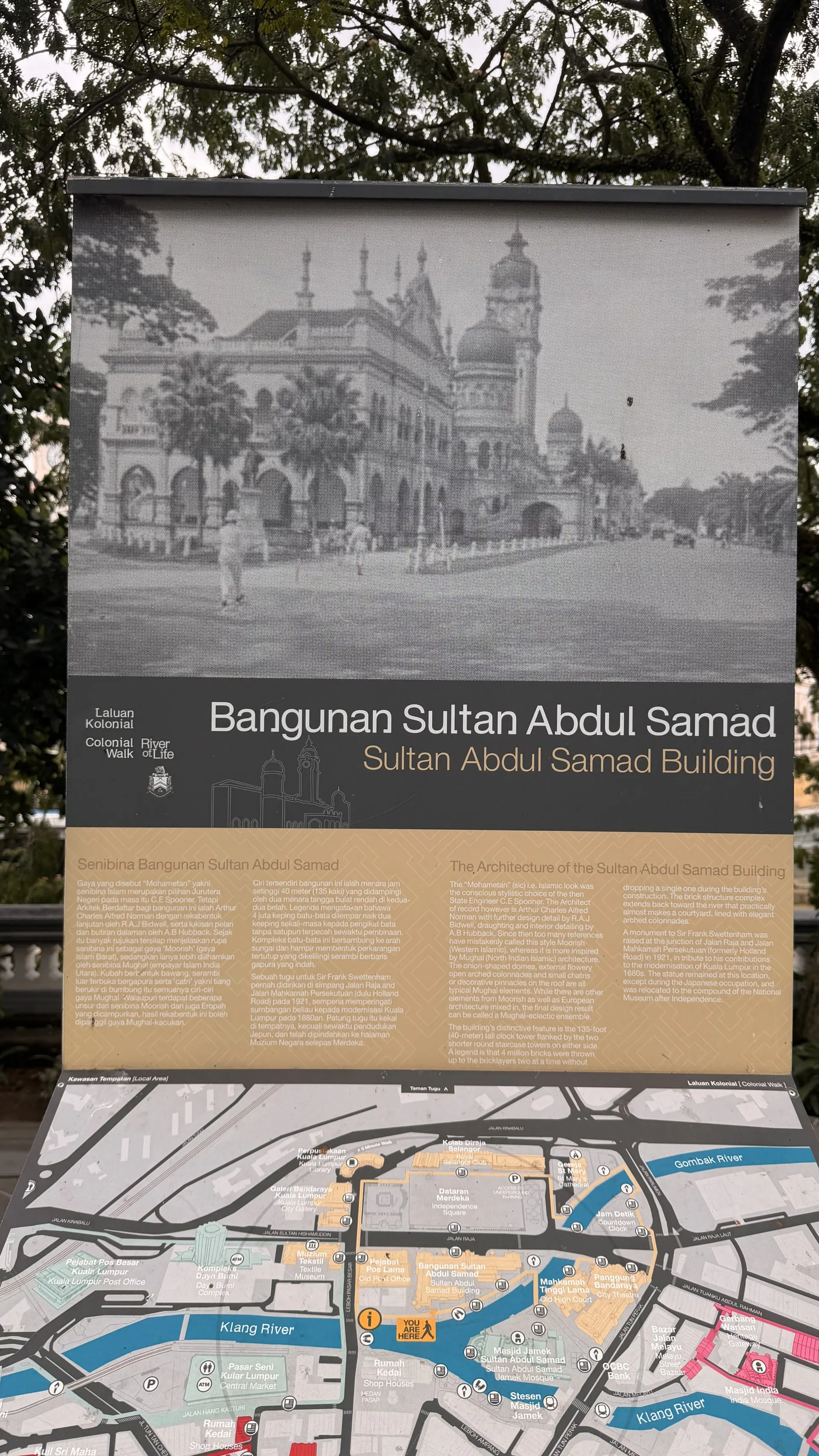
The Sultan Abdul Samad Building is Kuala Lumpur's most recognisable colonial-era landmark, built between 1894 and 1897 as the Government Offices of the British administration in Selangor and, from 1896, the Federated Malay States. Credited to architect A.C. Norman but largely designed by R.A.J. Bidwell in an Indo-Saracenic style, it used some 4 million bricks and cost 152,000 Straits dollars, with a 41-metre clock tower often called Malaysia's Big Ben. The Union Jack was lowered for the last time in front of it at midnight on 30 August 1957, and in 1974 it was renamed after Sultan Abdul Samad of Selangor, who reigned when construction began. After decades housing the FMS Secretariat, Malaysia's superior courts, and federal ministries, the building was restored under the Warisan KL initiative, and Block 1 reopened to the public on 2 February 2026 as the new home of the Kuala Lumpur City Gallery.
Government Offices
From completion in 1897
Federal Secretariat Building
Colonial era, as seat of the FMS administration
Bangunan Sultan Abdul Samad
Renamed 1974
3 September 1894
Construction begins on the new Government Offices facing the Padang (today's Dataran Merdeka). The foundation stone is laid on 6 October 1894 by Sir Charles Mitchell, Governor of the Straits Settlements. A.C. Norman is the architect of record, but state engineer C.E. Spooner rejects his Classical Renaissance design, and assistant architect R.A.J. Bidwell reworks it in the Indo-Saracenic style, with A.B. Hubback designing the fixtures.
4 April 1897
The building is officially opened as the administrative centre of the Federated Malay States. Construction consumed roughly 4 million bricks, 2,500 barrels of cement, 5,000 lbs of copper, and 50 tons of steel and iron, at a cost of 152,000 Straits dollars.
June 1897
The clock, made by Gillett & Johnston of Croydon, England, chimes for the first time during Queen Victoria's Diamond Jubilee parade. Its one-ton mechanism still strikes the hour today.
1939
The decorative spires atop the towers are removed as an air-raid precaution ahead of the Second World War. They would not return for 87 years.
30 August 1957
At the stroke of midnight, the Union Jack is lowered for the last time on the Padang in front of the building and the flag of the new Federation of Malaya is raised, marking independence. The event is why the square is now called Dataran Merdeka (Independence Square).
1971
Severe flooding in Kuala Lumpur damages the building, prompting calls for major repairs.
1974
The building is renamed Bangunan Sultan Abdul Samad, after the fourth Sultan of Selangor (reigned 1857 to 1898), under whose rule construction had begun.
1978
A six-year, RM17.2 million renovation begins, converting the building to house Malaysia's judiciary, including the Federal Court (later Supreme Court), the Court of Appeal, and the High Court of Malaya.
2007
The High Court of Malaya, the last court in residence, relocates to the Kuala Lumpur Courts Complex; the Federal Court and Court of Appeal had earlier moved to the Palace of Justice in Putrajaya. Federal ministries responsible for communications, tourism, and culture subsequently occupy the offices.
February 2025
An 11-month conservation of Block 1 begins under Warisan KL, a national heritage initiative launched in April 2025 and delivered by Khazanah Nasional through Dana Warisan, part of an RM600 million programme covering eight historic buildings in the capital.
2 February 2026
Block 1 reopens to the public with the relocated Kuala Lumpur City Gallery, immersive exhibition spaces, craft and retail areas, and cafes, open daily from 9am to 6pm. The restoration also reinstates the tower spires removed in 1939.
Clock tower
41 metres (135 ft) tall and nicknamed Malaysia's Big Ben. The clock was made by Gillett & Johnston of Croydon and first chimed in June 1897; its one-ton bell mechanism strikes every hour.
Copper onion domes
The clock tower and its two flanking stair towers are each crowned with a copper-clad onion dome. The domes were recoated and lit with LEDs in 2012, and the original spires, removed in 1939, were reinstated during the 2025-2026 restoration.
Blood-and-bandages brickwork
The facade's alternating exposed red brick and white plaster bands, built from roughly 4 million bricks, gave rise to the style's colonial-era nickname and defined the look of later government buildings along Jalan Raja.
Arched colonnades
Two storeys of horseshoe and ogee arched verandahs run the length of the facade facing Dataran Merdeka, an Indo-Saracenic device that shades the offices from tropical sun and rain.
Kuala Lumpur City Gallery (Block 1)
Since 2 February 2026, Block 1 houses the relocated KL City Gallery with immersive galleries on the city's history, a visitor centre, craft and retail spaces, and cafes including BakeHouse by KLCG and The Cafe by Royal Selangor.
Dataran Merdeka setting
The building forms the backdrop to Independence Square, where the Malayan flag was first raised in 1957, and remains the centrepiece of Merdeka Day and New Year celebrations.
Construction began on 3 September 1894 and the building was officially opened on 4 April 1897 as the Government Offices of the British colonial administration. It cost 152,000 Straits dollars and used around 4 million bricks.
A.C. Norman is the architect of record and his name appears on the foundation stone, but the executed Indo-Saracenic design is largely the work of his assistant R.A.J. Bidwell, working under state engineer C.E. Spooner, with A.B. Hubback designing the building's fixtures.
It was renamed in 1974 in honour of Sultan Abdul Samad, the fourth Sultan of Selangor, who reigned from 1857 to 1898 and was the ruler when construction began. Before that it was known simply as the Government Offices or the Federal Secretariat Building.
Yes. Since 2 February 2026, Block 1 is open to the public daily from 9am to 6pm following an 11-month restoration under the Warisan KL initiative. It houses the relocated Kuala Lumpur City Gallery, exhibition and craft spaces, and cafes. The rest of the complex is being restored in later phases.
It began as the secretariat of the Federated Malay States, housing the colonial administration's departments. From 1978 to 2007 it served as Malaysia's main court complex, home to the Supreme Court (later Federal Court), Court of Appeal, and High Court of Malaya, and afterwards housed federal ministries for communications, tourism, and culture.
The central clock tower stands 41 metres (135 ft) tall and is often called Malaysia's Big Ben. Its clock was made by Gillett & Johnston of Croydon and first chimed in June 1897 during Queen Victoria's Diamond Jubilee parade.
At midnight on 30 August 1957, the Union Jack was lowered for the last time on the Padang in front of the building and the flag of the independent Federation of Malaya was raised as the clock chimed. The square was later named Dataran Merdeka (Independence Square) to commemorate the event.
Sources