
Kuala Lumpur, Wilayah Persekutuan Kuala Lumpur
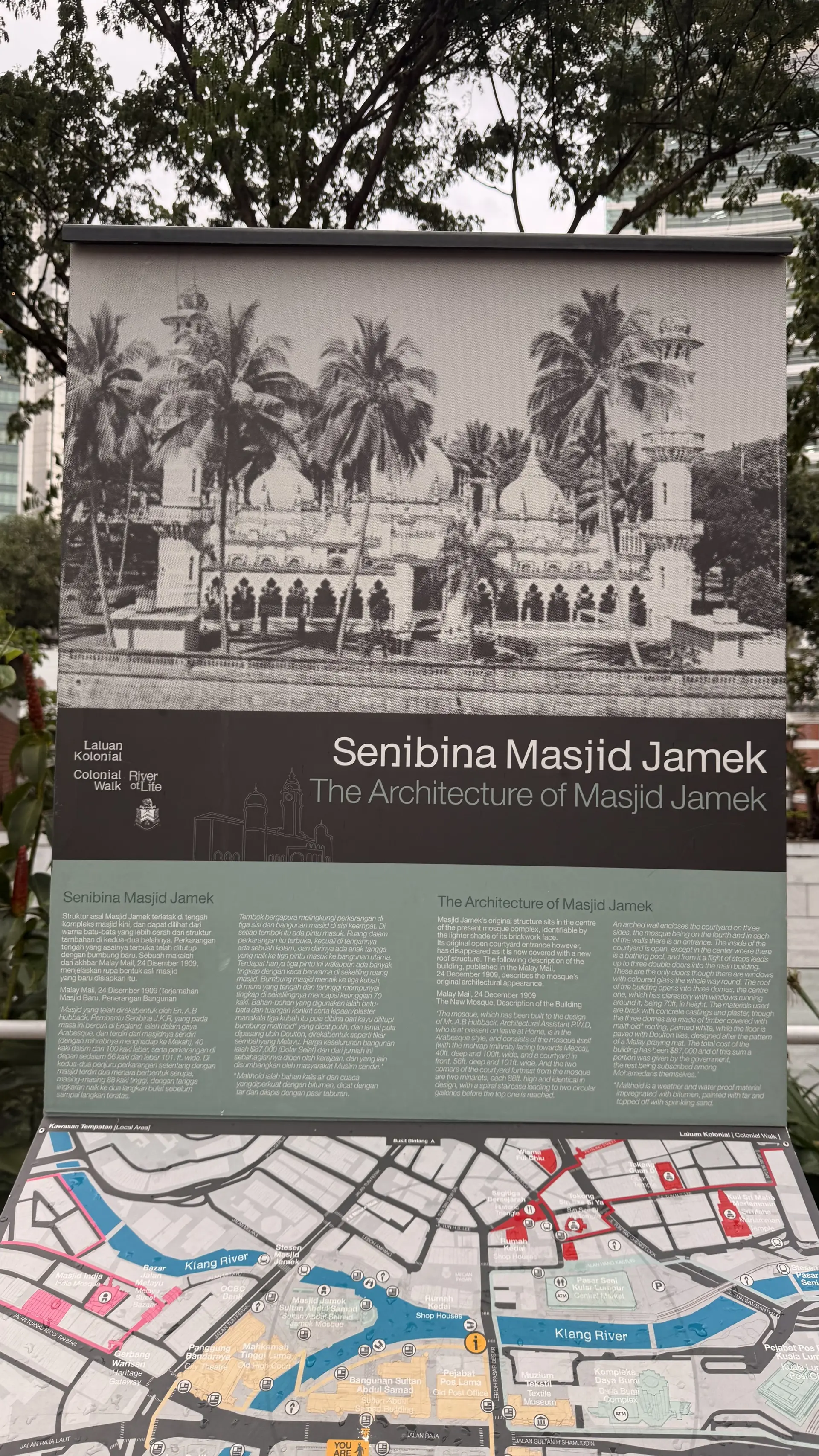
Masjid Jamek Sultan Abdul Samad, known simply as Jamek Mosque, is one of Kuala Lumpur's oldest surviving mosques, built in 1908 to 1909 at the confluence of the Klang and Gombak rivers, on ground that had served as the city's first Muslim burial ground. British colonial architect Arthur Benison Hubback designed it in an Indo-Saracenic style blending Mughal and Moorish elements, and Sultan Sir Alaeddin Sulaiman Shah of Selangor laid the foundation stone on 23 March 1908 before opening the finished building on 23 December 1909. It served as Kuala Lumpur's principal mosque for Friday prayers for more than half a century, until Masjid Negara opened in 1965, and in June 2017 Selangor's Sultan Sharafuddin Idris Shah renamed it after his ancestor, the fourth Sultan of Selangor. Since 2023, it has anchored Think City's RM20 million Masjid Jamek-Pasar Seni heritage corridor revamp, with an enclave-specific restoration plan reported in April 2025 as part of the wider Warisan KL programme.
Jamek Mosque (Masjid Jamek)
1909 to 2017
Sultan Abdul Samad Jamek Mosque (Masjid Jamek Sultan Abdul Samad)
since 23 June 2017
1890-1891
The triangular plot at the Klang-Gombak confluence, Kuala Lumpur's first Muslim burial ground, is cleared. The Sanitary Board had asked the Muslim community on 11 September 1890 to choose a replacement cemetery site on Ampang Road, and the old ground was fenced off by 1891, though not every grave was moved and old headstones survive in the mosque's gardens today.
23 March 1908
Sultan Sir Alaeddin Sulaiman Shah of Selangor lays the foundation stone for the new mosque, designed by Federated Malay States Public Works Department architect Arthur Benison Hubback in an Indo-Saracenic style unusual for a mosque of its era.
1908-1909
The mosque is built for around 33,000 Straits dollars, raised jointly from the Selangor government, the sultan and Malay community subscriptions.
23 December 1909
Sultan Alaeddin Sulaiman Shah returns to officially open the completed mosque, which becomes Kuala Lumpur's principal congregational mosque.
1965
Masjid Negara, Malaysia's National Mosque, opens a short distance away and takes over as Kuala Lumpur's main mosque, ending Masjid Jamek's 56-year run as the city's principal place of Friday prayer.
1984
The mosque is refurbished, and the minaret closest to the riverbank is underpinned after engineers find it has begun sloping.
1993
One of the mosque's three domes collapses during unusually heavy rain. It is rebuilt and all three domes are subsequently reinforced.
2009
The mosque is gazetted as a National Heritage Site.
23 June 2017
Selangor's Sultan Sharafuddin Idris Shah renames the mosque Sultan Abdul Samad Jamek Mosque, after his ancestor Sultan Abdul Samad, the fourth Sultan of Selangor, who reigned from 1857 to 1898. Around the same period, a River of Life refurbishment adds giant shade canopies modelled on Masjid Nabawi in Madinah and lifts capacity to 1,000 worshippers.
November 2023 to April 2025
Think City commits RM20 million from Budget 2024 to a Masjid Jamek-Pasar Seni heritage corridor revamp. By April 2025 this has grown into a dedicated Masjid Jamek Enclave Action Plan restoring the mosque and its surrounding public spaces, reported as part of the wider Warisan KL programme, alongside a Kuala Lumpur bid for UNESCO Creative Cities Network recognition.
Twin minarets
The two flanking minarets stand about 26.8 metres (88 feet) tall with pink and white banded brick and plaster. The one nearest the riverbank had to be underpinned in 1984 after it was found to be sloping on the soft confluence ground.
Three onion domes
The central dome rises 21.3 metres (70 feet) above the prayer hall, following the Mughal-influenced onion shape. Built as a timber structure, one dome collapsed in a 1993 storm and all three were subsequently rebuilt and reinforced.
Courtyard shade canopies
The mosque's courtyard was originally open to the sky and was later roofed over. A River of Life-era refurbishment added large tent-like shade canopies modelled on those at Masjid Nabawi in Madinah, part of an upgrade that also raised capacity to 1,000 worshippers.
Old headstones in the gardens
Before the mosque was built, the confluence site was Kuala Lumpur's first Muslim burial ground. It was cleared and fenced by 1891, but not every grave was relocated, and old headstones can still be found among the gardens surrounding the mosque.
Heritage-listed status
Gazetted a National Heritage Site in 2009, the mosque now anchors Think City's Masjid Jamek-Pasar Seni cultural corridor, a heritage revamp backed by RM20 million from Budget 2024 and expanded into a dedicated restoration plan reported in 2025.
Sultan Sir Alaeddin Sulaiman Shah of Selangor laid the foundation stone on 23 March 1908, and he returned to officially open the completed mosque on 23 December 1909. Construction took about 21 months and was funded jointly by the Selangor government, the sultan and Malay community subscriptions.
The mosque was designed by Arthur Benison Hubback, a British architect working for the Federated Malay States Public Works Department in the early 1900s. It was one of his first major Kuala Lumpur commissions, and he went on to design the nearby Kuala Lumpur railway station and the Ubudiah Mosque in Kuala Kangsar in a similar idiom.
The confluence site was Kuala Lumpur's first Muslim burial ground. The Sanitary Board directed the Muslim community to a new cemetery on Ampang Road in September 1890, and the old ground was cleared and fenced by 1891, though not every grave was relocated and some old headstones remain in the mosque's gardens today.
On 23 June 2017, Selangor's Sultan Sharafuddin Idris Shah renamed the mosque after his ancestor, Sultan Abdul Samad, the fourth Sultan of Selangor who reigned from 1857 to 1898, since the mosque stood on land within Selangor's historical domain. The Federal Territories minister at the time said the move was part of efforts to preserve national heritage.
One of the mosque's three domes collapsed during unusually heavy rain in 1993. It was rebuilt and all three domes were structurally reinforced afterwards, following an earlier 1984 refurbishment in which the minaret closest to the river had to be underpinned because it was sloping.
Yes, from its 1909 opening it served as Kuala Lumpur's principal mosque for congregational Friday prayers for more than 55 years, a role it held until the National Mosque, Masjid Negara, opened in 1965.
Since Budget 2024, Think City has led a RM20 million revamp of the Masjid Jamek-Pasar Seni heritage corridor, including a dedicated Masjid Jamek Enclave Action Plan to restore the mosque and improve the public spaces around it. As reported in April 2025, this sits within the wider Warisan KL programme, which is also pursuing UNESCO Creative Cities Network recognition for Kuala Lumpur.
Sources