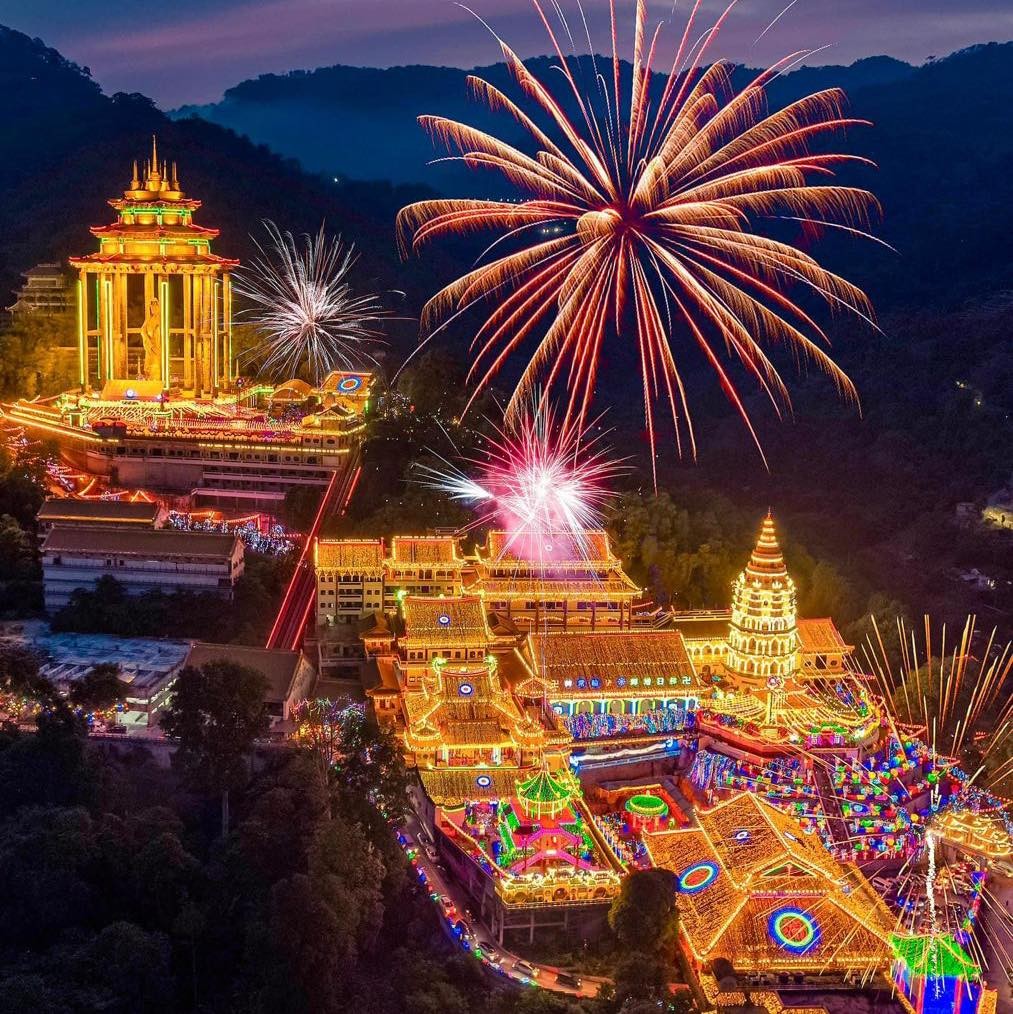
A close orbit of Penang's most iconic Buddhist temple complex - the three-tiered Ban Po Thar pagoda blending Chinese, Thai and Burmese design, then up the hillside to the 30-metre bronze Kuan Yin statue overlooking Georgetown and the sea.
Play interactive tourTucked into the hills above George Town, Kek Lok Si has been under construction, expansion and pilgrimage since 1890 - Southeast Asia's largest Buddhist temple complex.
Founded in 1890 by Chinese Buddhist monk Beow Lean and funded by the local Hokkien community, the complex took over 20 years just to complete its main pagoda.
Officially the Pagoda of Rama VI, its seven storeys mix three design traditions in one structure - starting with a Chinese octagonal base built in traditional pavilion style.
Above the Chinese base, the middle storeys shift to Thai temple architecture - a deliberate nod to the region's Buddhist traditions beyond just the Hokkien community that built it.
The pagoda crowns itself with a golden Burmese stupa at the top - Chinese base, Thai middle, Burmese peak, a three-in-one design unlike any other pagoda in the country.
An inclined lift carries visitors further up the hillside to the complex's second icon - a bronze statue of Kuan Yin, the Buddhist Goddess of Mercy, unveiled in its current form in 2009.
Standing just over 30 metres tall, this is one of the largest Kuan Yin statues in the world - replacing an earlier statue damaged by weather and rebuilt inside a purpose-built pavilion.
The pavilion sheltering the statue was completed in 2009 after years of construction - its roofline styled after a lotus, the flower most associated with the Goddess of Mercy across Buddhist iconography.
Devotees release turtles here as an act of merit-making, a tradition tied to the animal's association with longevity in Chinese Buddhist belief - the pond has held generations of them.
Pulling back from over a century of continuous building and pilgrimage - Kek Lok Si sits on the hills above George Town's UNESCO core, with the Strait of Malacca beyond.