
Kuala Lumpur, Wilayah Persekutuan Kuala Lumpur
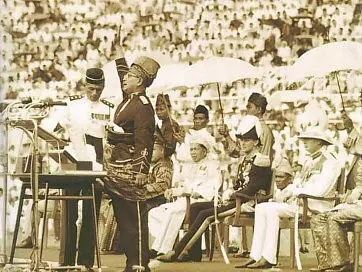
Stadium Merdeka is an open-air stadium in Kuala Lumpur, built by Malaya's Public Works Department under American architect Stanley Edward Jewkes and completed on 21 August 1957 at a cost of M$2.3 million. Its cantilevered concrete shell grandstand roof and prestressed floodlight towers were, at completion, among the largest and tallest structures of their kind in the world, engineered to shade spectators without a single interior column. Ten days after completion, on 31 August 1957, Tunku Abdul Rahman proclaimed Malaya's independence here before more than 20,000 people, punching the air and shouting "Merdeka!" seven times, and the stadium hosted the formation of Malaysia on 16 September 1963 before more than 30,000. It went on to host four Southeast Asian Games, the 1975 Hockey World Cup final, and a 1975 Muhammad Ali exhibition bout, before Permodalan Nasional Berhad's Merdeka Heritage Trust spent RM13.7 million stripping back decades of additions to restore its original 1957 form, reopening the stadium to the public on 17 August 2024.
25 September 1956
Groundbreaking begins on a site beside the Selangor Club padang, after Chief Minister Tunku Abdul Rahman personally tasks Stanley Edward Jewkes, an American architect and Deputy Director of the Public Works Department, with designing a stadium for the coming independence ceremony.
21 August 1957
Construction finishes in under a year at a cost of M$2.3 million, with engineers Lee Kwok Thye, Chan Sai Soo and Peter Low delivering a cantilevered concrete shell roof and prestressed floodlight towers built from stacked Hume concrete culvert pipes without cranes, both world records at the time.
31 August 1957
Tunku Abdul Rahman proclaims the independence of the Federation of Malaya before more than 20,000 spectators, raising his fist and shouting "Merdeka!" seven times, a moment that gives the stadium its name.
16 September 1963
More than 30,000 people fill the stadium to witness the proclamation of Malaysia, formed from the merger of Malaya, Singapore, Sabah and Sarawak.
1965-1989
The stadium serves as the main venue for four editions of the Southeast Asian (Peninsular) Games, in 1965, 1971, 1977 and 1989, and as home ground for the Malaysian national football team and Selangor FC, hosting more than 36 Malaysia Cup finals.
1975
Stadium Merdeka hosts the final of the Hockey World Cup, where India beat Pakistan 2-1 in front of over 50,000 spectators, and on 1 July that year draws around 20,000 for an exhibition bout between Muhammad Ali and Joe Bugner.
1989
Reinforced concrete upper tiers are added ahead of that year's Southeast Asian Games, expanding capacity to around 45,000 but departing from Jewkes' original tropical-climate design and covering up the 1957 structure.
2005
Stadium Merdeka is gazetted as a national heritage site, and Permodalan Nasional Berhad, through its Merdeka Heritage Trust established the following year, commits to reversing the 1989 additions and restoring the stadium to its original 1957 form.
September 2008
The restoration work already completed on the stadium wins the UNESCO Asia-Pacific Award of Excellence for Heritage Conservation.
2016
The stadium closes to the public as the Merdeka Heritage Trust undertakes a further, extended phase of restoration and structural repair works.
17 August 2024
Stadium Merdeka reopens after a restoration costing RM13.7 million in total, its seating capacity brought back down to around 20,000 with the original timber-strip terraces, 1957-style scoreboard and entrance tiling reinstated, and a new lift added to the east terrace for accessibility.
Cantilevered shell roof
The main grandstand's concrete shell roof cantilevers out over the seating without any supporting columns behind it, at completion in 1957 the largest structure of its kind in the world and still the stadium's defining silhouette.
Hume-pipe floodlight towers
The four 120-foot floodlight towers were built by stacking prestressed Hume concrete culvert pipes on top of each other without using cranes, an improvised construction method that also set a world record for tower height at the time.
Earthed amphitheatre bowl
Much of the seating bowl is cut into and banked with earth rather than built up on a raised concrete frame, a design that keeps the structure lower, cooler and less visually dominant than a conventional stadium of the same capacity.
Restored 1957 terraces and scoreboard
The 2016-2024 restoration removed the reinforced-concrete tiers added for the 1989 Southeast Asian Games and replaced plastic seating with timber-strip benches, while rebuilding the scoreboard and entrance floor tiling to match the original 1957 design.
Public running track
Since reopening in 2024, the stadium's track is open to the public for free during set hours on weekday mornings and evenings and weekend mornings and afternoons, alongside its continued use as a venue for matches and private events.
Stadium Merdeka was designed by Stanley Edward Jewkes, an American architect serving as Deputy Director of Malaya's Public Works Department, after Tunku Abdul Rahman personally commissioned him in 1956. Engineers Lee Kwok Thye, Chan Sai Soo and Peter Low worked on its cantilevered roof and floodlight towers.
On completion in August 1957, its cantilevered concrete shell grandstand roof was the largest of its kind in the world, and its 120-foot prestressed floodlight towers, built from stacked Hume concrete culvert pipes, were the tallest of their type. Both were engineering firsts achieved without cranes on site.
Reinforced concrete tiers added ahead of the 1989 Southeast Asian Games had expanded capacity to around 45,000 but departed from Jewkes' original tropical-climate design and created structural problems. From 2005, Permodalan Nasional Berhad's Merdeka Heritage Trust worked to strip these additions back and restore the stadium's original form, materials and natural ventilation.
The stadium opened in 1957 with roughly 20,000 seats, which grew to around 45,000 after reinforced concrete tiers were added for the 1989 Southeast Asian Games. The 2005-2024 restoration removed those later additions and returned capacity to close to its original 20,000.
Beyond the 1957 independence declaration, the stadium hosted four Southeast Asian Games (1965, 1971, 1977 and 1989), more than 36 Malaysia Cup finals, the 1975 Hockey World Cup final between India and Pakistan, and a 1975 exhibition boxing match between Muhammad Ali and Joe Bugner.
Merdeka is the Malay word for independence or freedom, derived from the Sanskrit maharddhika. The stadium takes its name from the independence proclamation held there on 31 August 1957, when Tunku Abdul Rahman shouted the word seven times.
The stadium closed to the public in 2016 for an extended phase of restoration and structural repair under the Merdeka Heritage Trust. It reopened on 17 August 2024 after a combined restoration cost of RM13.7 million, with its original 1957 seating, scoreboard and entrance tiling reinstated.
Sources