
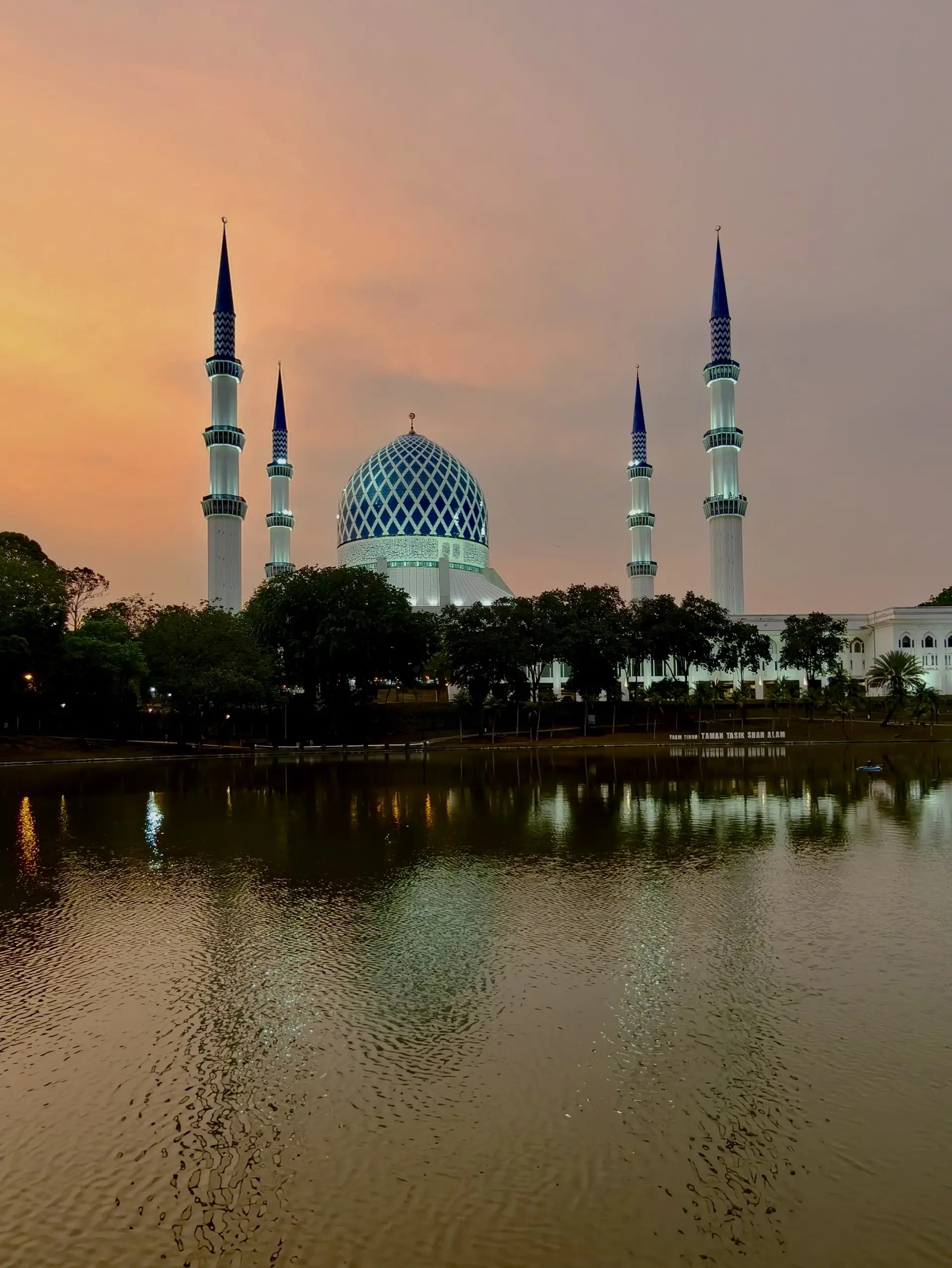
Shah Alam, Selangor
The Sultan Salahuddin Abdul Aziz Shah Mosque, popularly called the Blue Mosque, is Selangor's state mosque and Malaysia's largest, standing at the centre of Shah Alam. Sultan Salahuddin Abdul Aziz Shah commissioned it after declaring Shah Alam the state's new capital on 14 February 1974, days after ceding Kuala Lumpur to the federal government. Built between 1982 and 1988 to a design by architect Dato Baharuddin Abu Kassim, the mosque was officially opened by the Sultan on 11 March 1988. Its signature blue-and-silver dome rises 106.7 metres and spans 51.2 metres across, the largest of its kind in Southeast Asia, while its four corner minarets, each 142.3 metres tall, form the tallest group of minarets in the world. The prayer halls seat up to 24,000 worshippers and are finished in Langkawi marble with Egyptian calligraphy. In 2025 the mosque drew more than 100,000 tourists, underlining its role as both a working mosque and one of Malaysia's most visited Islamic landmarks.
Blue Mosque
Popular English nickname in use since the mosque's 1988 opening, after its blue-and-silver dome
Masjid Negeri Selangor (State Mosque of Selangor)
Official state mosque designation, held since consecration on 11 March 1988
1 February 1974
Sultan Salahuddin Abdul Aziz Shah signs the cession of Kuala Lumpur from Selangor to the federal government, making it a Federal Territory and leaving Selangor without a capital.
14 February 1974
Two weeks later, the Sultan declares Shah Alam, a name chosen in part for his late father Sultan Alam Shah, as Selangor's new state capital, later formally proclaimed on 7 December 1978. A grand state mosque is commissioned as the new capital's centrepiece.
1982
Construction begins on the mosque to a design by architect Dato Baharuddin Abu Kassim of Jurubena Bertiga (JBIS), commissioned through Malaysia's Public Works Department (JKR), blending Malay design with modernist form.
11 March 1988
Sultan Salahuddin Abdul Aziz Shah officially opens and consecrates the mosque, which is named after him and designated Selangor's state mosque.
August 1993
Casablanca's Hassan II Mosque completes a 210-metre minaret, surpassing the individual height record the Shah Alam mosque's minarets had held; its four 142.3-metre minarets together remain the tallest group of minarets in the world.
1999-2001
Sultan Salahuddin Abdul Aziz Shah, the mosque's namesake, serves as Malaysia's tenth Yang di-Pertuan Agong (King) from 26 April 1999 until his death in office on 21 November 2001.
2025
Guided-tour and Mosque Open Day programmes under the Masjid Negeri Selangor Guide initiative help draw more than 100,000 tourists to the mosque over the year, Grand Imam Datuk Muhammad Farhan Wijaya reports, with visitors travelling from Europe, West Asia, Japan and China.
The blue-and-silver dome
Rising 106.7 metres and spanning 51.2 metres across, built from aluminium with vitreous-enamel-baked steel panels and ringed by a rosette of Quranic verses, it is the largest dome of its kind in Southeast Asia.
Four 142.3-metre minarets
One at each corner of the mosque, together forming the tallest group of minarets in the world; individually they ranked among the world's tallest until Casablanca's Hassan II Mosque surpassed them in 1993.
Prayer hall interior
A two-level hall seating up to 24,000 worshippers (12,600 in the main hall), carpeted in Belgian worsted wool, with an upper gallery reserved for women, Langkawi white marble and granite finishes, a mimbar carved from Kelantanese wood, and a mihrab of layered white marble arches.
Calligraphy and ceiling craftsmanship
Interior calligraphy was executed by Egyptian calligrapher Sheikh Abdel Moneim Mohamed Ali El Sharkawi, beneath a high ceiling of red balau and ramin timber panels arranged in a crisscross pattern.
Garden of Islamic Arts
A 14-hectare landscaped park adjoining the mosque, laid out with nine galleries showcasing Islamic art and design.
Construction ran from 1982 to 1988. Sultan Salahuddin Abdul Aziz Shah, after whom it is named, officially opened the mosque on 11 March 1988, several years after he had declared Shah Alam Selangor's new state capital in 1974.
Malaysian architect Dato Baharuddin Abu Kassim of Jurubena Bertiga (JBIS) designed it for the Public Works Department (JKR), blending traditional Malay architectural elements with a modernist form.
The nickname comes from its dome, minarets and stained-glass windows, finished in blue and silver. Its official name honours Sultan Salahuddin Abdul Aziz Shah, who commissioned and later opened it.
Each of the four corner minarets stands 142.3 metres tall. Together they form the tallest group of minarets in the world, though individually Casablanca's Hassan II Mosque surpassed them with a single 210-metre minaret in 1993.
Yes. It is Malaysia's largest mosque and the second largest in Southeast Asia by capacity, seating up to 24,000 worshippers across its two-level prayer hall in Shah Alam, Selangor's state capital.
After Sultan Salahuddin Abdul Aziz Shah ceded Kuala Lumpur to become a Federal Territory on 1 February 1974, he declared Shah Alam Selangor's new capital two weeks later and commissioned this mosque as its landmark centrepiece, completed in 1988.
Sources