A street-level walk through George Town's UNESCO World Heritage core - from the star-shaped fort that founded British Penang, past the Street of Harmony's mosque and church, through a Hakka merchant's blue mansion and Southeast Asia's most elaborate Chinese clan temple, to the mural that started Georgetown's street-art boom and the clan jetty still lived on today.
Play interactive tourMalaysia's Pearl of the Orient - eight streets of colonial forts, clan temples, mosques and Peranakan mansions packed into George Town's UNESCO-listed heritage core, inscribed alongside Melaka in 2008.
Built in 1786 by Captain Francis Light on the very spot he landed, this star-shaped fort marks the founding of British Penang - Malaysia's oldest standing fort, though it never actually fired a shot in battle.
A centuries-old Dutch-cast cannon captured from pirates in 1795, said by local folklore to grant fertility to those who leave flowers in its barrel - one of the fort's most visited relics.
Consecrated in 1818 and built using convict labour under the East India Company, its Greco-Roman portico and memorial to Francis Light make it the oldest purpose-built Anglican church in Southeast Asia.
Built by Hakka merchant Cheong Fatt Tze - once dubbed 'the Rockefeller of the East' - this indigo-washed mansion follows strict feng shui principles across 38 rooms and 5 granite-paved courtyards.
Founded around 1801 by South Indian Muslim trader Cauder Mohuddeen, this mosque anchors the aptly named Street of Harmony, where a mosque, temples and a church all stand within a few minutes' walk.
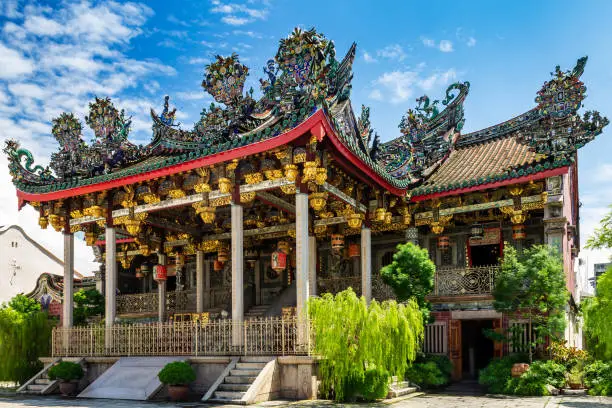
Southeast Asia's most elaborate Chinese clan temple - legend says the original 1894 building was so grand it 'offended the gods' and burned down the night it was completed, rebuilt more humbly by 1906.
Every beam, pillar and eave was carved by artisans brought over from China - dragons, phoenixes and scenes from Chinese opera crowded onto a roofline built to honour a single clan's ancestors.
Once home to 19th-century Kapitan Cina Chung Keng Kwee, this mansion fuses Chinese carved woodwork with English ironwork and Scottish floor tiles - now a museum holding over a thousand Peranakan antiques.
Painted in 2012 by Lithuanian artist Ernest Zacharevic for the George Town Festival, this mural of two children on a real bicycle propped against the wall kicked off Georgetown's street-art tourism almost overnight.
Home to the Chew clan for over a century, this stilt village still stands on the waterfront its residents' ancestors settled - one of Georgetown's last living clan jetties, and where this heritage walk ends.