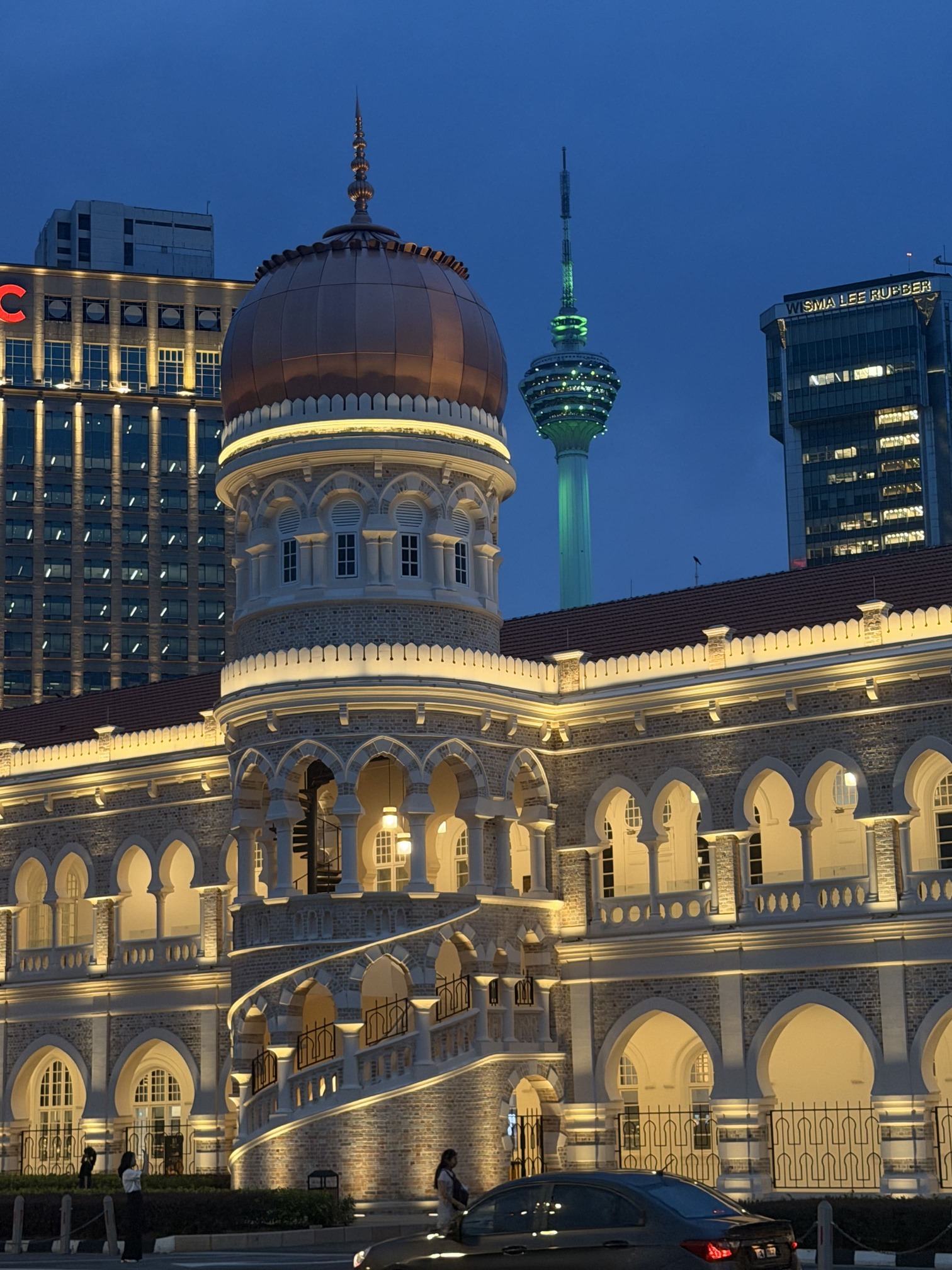
A close orbit of Kuala Lumpur's most photographed colonial landmark - from the river confluence where the city began, past the clock tower that watched independence unfold across the Padang, to a street-level walk along its colonnade arches. Dataran Merdeka, Masjid Jamek and the River of Life all sit within sight.
Play interactive tourKuala Lumpur's most photographed colonial landmark, at the river confluence where the city was founded - Masjid Jamek, Dataran Merdeka and the River of Life all sit within a few steps.
137 metres of Moorish arches and striped brickwork, built 1897 to house British colonial rule - directly across the Padang from where independence would be declared six decades later.
The 41-metre clock tower has kept time over the Padang since 1897 - the same square where the Union Jack came down at midnight, 31 August 1957.
Arched colonnades wrap the western wing, echoing the same Mughal and Islamic design language as Masjid Jamek across the river.
Onion domes, copper-clad and green with age, rise above every wing - visible from Masjid Jamek's own minarets just downstream.
The building's eastern face looks out over the Klang River, at the exact confluence that gave Kuala Lumpur its name - 'muddy confluence'.
The tightest shot yet - horseshoe arches and striped brick, a full circle around KL's oldest icon.
Dropping to street level - where the arcade's arches meet the pavement, at a walker's pace.
Arch after horseshoe arch, the colonnade stretches on - built for walking, not driving past.
The clock tower rises directly overhead - the same view a pedestrian gets craning their neck up, just steps from where a nation once celebrated its first hour of independence.
One last step in, through an arch that has watched this confluence since 1897 - the mosque and the river still visible beyond it, just as they were in 1897.